Charitable Raffles and Art Unions in Australia: Fundraising Laws and Permit Requirements

Charitable raffles and art unions are among the most common fundraising tools used by community and not-for-profit organisations across Australia. They are also among the most frequently misunderstood from a legal perspective.
The answer to "do we need a permit to run a raffle?" is: often “yes”, depending on where the raffle is conducted and the total value of tickets or prizes involved. Getting it wrong can expose an organisation to significant fines, enforcement action and reputational damage.
This guide explains what charitable raffles and art unions are, when a permit is required, how the location of a raffle is determined for legal purposes, and what rules apply once a raffle is underway.
Author: Ben Daley, Senior Associate / Daniel Lovecek, Principal
What is a Charitable Raffle or Art Union?
A raffle (also called an art union in some Australian jurisdictions) is a type of lottery in which participants purchase tickets for the chance to win prizes. The key feature that distinguishes a charitable raffle from a commercial lottery or trade promotion is the purpose behind it: to be lawful, a charitable raffle must be conducted by a charitable or community organisation for approved purposes. Prize winners are determined based on a draw mechanic involving physically or electronically selecting a winning ticket or tickets from those purchased.
Approved purposes include advancing health, education or social welfare, as defined under the Charities Act 2013 (Cth) and, for raffle permit purposes, each state and territory jurisdiction’s gaming legislation.
This is why the activity is commonly referred to as a "charitable raffle" or "charitable lottery" rather than simply a prize draw or competition. The organisational purpose is a threshold legal requirement, not merely a label.
Why Are Permits Required for Charitable Raffles?
Charitable raffles and art unions are regulated activities in every Australian state and territory. Permit requirements exist to ensure transparency, fairness, and the appropriate distribution of funds raised through ticket sales.
Licensing and permit frameworks protect participants by requiring that:
proceeds from ticket sales are used for legitimate charitable purposes;
prizes are awarded fairly and in accordance with disclosed rules;
records are kept and made available for regulatory review; and
third parties who assist with the conduct of raffles meet their own licensing obligations where required.
Each Australian jurisdiction has its own regulatory framework, and the specific requirements, thresholds, and conditions vary. There is no single national permit for charitable raffles.
When Do You Need a Permit to Run a Raffle in Australia?
Whether a permit is required depends on two primary factors: where the raffle is being conducted, and the total value of tickets for sale or prizes on offer.
Factor 1: Where is the raffle being "conducted"?
For regulatory purposes, a raffle is subject to the laws of the jurisdiction or jurisdictions in which it is being "conducted." This is a more complex question than it first appears, particularly for raffle operators that accept ticket purchases from participants across multiple states and territories.
There is no recent judicial guidance on this question, and the relevant legislative provisions in most jurisdictions do not define the term"conduct" with precision or provide clear guidance on how to resolve it. A number of factors may impact this assessment, including (but not limited to) where and how advertising is being undertaken, the eligibility criteria specified by the raffle operator and any controls that are applied to govern participation.
Organisations planning to sell tickets to participants across multiple states and territories should seek legal advice before launching. The compliance obligations can multiply across jurisdictions, and the consequences of operating without the required permits could be serious.
Factor 2: What is the value of tickets or prizes?
Once the relevant jurisdiction or jurisdictions have been identified, the need for a permit typically depends on whether the total value of tickets for sale or prizes on offer exceeds a prescribed threshold. Those thresholds differ between jurisdictions.
The table below provides a general overview of permit thresholds by jurisdiction. It is intended as a guide only; organisations should confirm current requirements with the relevant regulatory body or seek legal advice before proceeding.
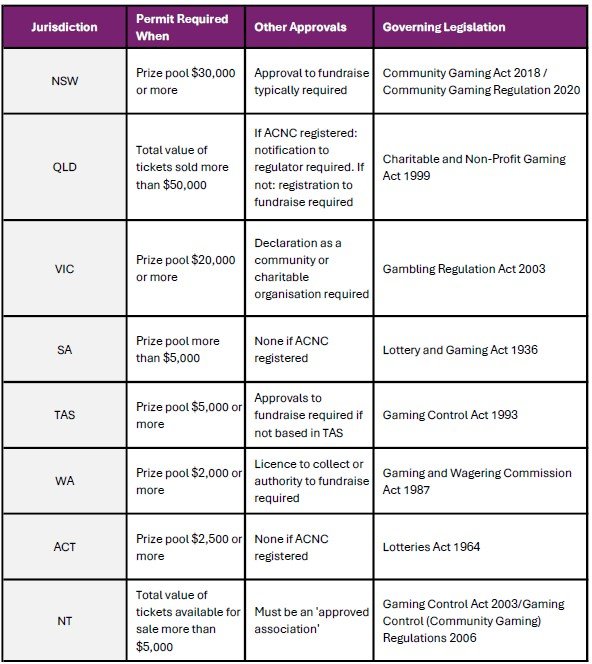
Note: thresholds and requirements are subject to change. Always verify current requirements with the relevant regulatory body or seek legal advice before proceeding.
It is important to note that permit thresholds are not exemptions from regulation. In New South Wales, for example, raffles with prize pools under $30,000 (which do not require a permit) must still comply with minimum conditions regarding rules, record keeping and the distribution of prizes.
Download the Permit Threshold Reference Sheet (PDF)
What Rules Apply to Charitable Raffles in All Jurisdictions?
Regardless of whether a permit is required, most Australian states and territories impose minimum legislative requirements on the conduct of charitable raffles. These commonly include obligations relating to:
• advertising and promotional restrictions;
• eligibility of participants;
• ticketing requirements and game rules;
• prize pool limits and the process for distributing prizes, including mandatory requirements for dealing with unclaimed prizes;
• the conduct of prize draws and publication of results;
• record keeping and auditing; and
• how proceeds from ticket sales may be distributed.
While these requirements share a common character across jurisdictions, the specific obligations differ in each state and territory. Organisations should not assume that compliance in one jurisdiction means compliance in another.
This is particularly important where a third party is assisting with the conduct of the raffle, or where a third party is being paid a commercial fee to provide those services. In Victoria, for example, such a third party may be required to hold a "commercial raffle organiser" licence before it can lawfully provide those services. There are also limits on how much such persons can be paid for assisting in the conduct of a raffle.
________________________________________
What Are the Consequences of Non-Compliance?
Conducting a raffle without the required permit, or in breach of applicable regulations, can result in significant financial penalties, enforcement action and reputational damage. For charitable and community organisations that depend on public trust, the reputational consequences of non-compliance can be just as damaging as the legal ones.
Compliance is not only a legal requirement. It is also a matter of good governance and organisational integrity, particularly for organisations that hold themselves out to the public as fundraising for charitable purposes.
________________________________________
Frequently Asked Questions:
Charitable Raffles and Fundraising Laws in Australia
Do community sports clubs need a permit to run a raffle?
In most cases, yes. The permit requirement will depend on the jurisdiction in which the raffle is being conducted and the total value of tickets or prizes involved. Sports clubs should seek legal advice before proceeding, as the specific requirements will vary depending on their circumstances and the states or territories in which they operate.
Can a raffle be run nationally across all Australian states and territories?
A raffle can accept ticket purchases from participants across multiple states and territories, but doing so typically means the organiser must comply with the laws of each relevant jurisdiction. This may require multiple permits and compliance with multiple regulatory frameworks simultaneously. It is strongly recommended that organisers seek legal advice before offering tickets to residents across multiple jurisdictions.
What is the difference between a charitable raffle and a trade promotion lottery?
A charitable raffle is conducted by a charitable or community organisation to raise funds for approved purposes. A trade promotion lottery (also called a promotional lottery) is run by a business to promote the sale of its goods or services. Entry must be free (although the purchase of a good or service ordinarily offered by the business can be required). The two are subject to entirely different regulatory regimes. However, both are subject to the Australian Consumer Law (s.18 of the Competition and Consumer Act 2010 (Cth)), which prohibits misleading or deceptive conduct in connection with the promotion — including misleading representations about prize values, odds, or the charitable purpose of the fundraiser. Organisations that are uncertain whether their activity is a raffle or a trade promotion should seek legal advice before proceeding.
What happens if prize winners cannot be located?
Most Australian jurisdictions have mandatory processes for dealing with unclaimed prizes. The specific requirements vary between states and territories. Organisations should ensure they understand their obligations in each relevant jurisdiction before conducting a raffle.
Do online raffles require a permit?
The fact that a raffle is conducted online does not exempt it from permit requirements. However, determining which jurisdiction's laws apply to an online raffle is a complex question. As noted above, this issue has not been subject to recent court judgments, and the relevant legislation does not provide clear guidance. Organisations planning to conduct raffles online, particularly where tickets may be available to residents across multiple states and territories, should seek legal advice before proceeding.
________________________________________
How Senet Can Help
Navigating the regulatory requirements for charitable raffles and art unions across Australia is a complex task, particularly for organisations planning to operate across multiple jurisdictions or to engage third-party service providers.
Senet advise a range of charitable organisations, community groups, sporting clubs, and commercial raffle operators on permit applications, regulatory compliance, and the conduct of fundraising activities across Australia.
If you are planning a raffle, art union or other fundraising lottery and would like to understand your obligations, we are here to assist.